Showing posts with label parenting books. Show all posts

Wednesday, September 16, 2015

Peaceful Parent, Happy Siblings Chapter 6 and 7: Reason and Sharing

This is the latest installment in the Round Table that Natural Parents Network is doing for Peaceful Parent, Happy Siblings by Dr. Laura Markham. Head on over for other reflections and reviews!

Sharing the magnifying glass to inspect their new friend, Caterpilly.
Chapter 6, entitled Why Can't They Just Share? Why Kids Fight Over Possessions, is pretty short and concise. The gist is this: the views most parents have on sharing are flat-out wrong. They aren't actually fair and they don't work in real life.  My own example: Kid A is playing with a light-up laptop, making things flash and making his own music and giggling and dancing. Kid Rock wants to play with the laptop because it looks SO DANG FUN! Mama June says "oh, Kid A, Kid Rock wants to play with that. Why don't you let him play for a while?" She reaches in and slides to laptop over to Kid Rock. Or, in some cases, Kid Rock reaches over and grabs the laptop for himself and Mama June affirms this behavior with the same line as above.  Now let's make the kids 15 years older. Kid A is working on a real laptop mixing his newest album and Kid Rock wants to make his own album. If Kid A were forced to stop working so Kid Rock could work, everyone would think Kid Rock was a giant asshole. In the real world, Kid Rock would have to wait until Kid A was finished or get his own damn laptop. 

Play is the Serious Work of Childhood. 

If we want to raise respectful humans, we need to start respecting them from their first breath. 

Alternatives to interruption and disrespect?

"Hey, Kid A, when you get to a good stopping point, let Kid Rock have a go, ok? Thanks!" 
"Hey Kid Rock, Kid A is playing with that right now, but when he's finished you can definitely have a turn. Promise." And if there are a lot of kids, you can add: "Let's start a list, so everyone gets a turn." If the kids get the concept of time, you could even set a timer so there's an even rotation. 

Working together to build a new rocket toy. 
Dr. Markham recommends that everyone get a copy of It's Ok Not To Share and give it a good read.  If you want a read-along for that, Amanda Morgan at Not Just Cute participated in one last year. She has some amazing insight. (And for the record, hers is one of my favorite blogs. I highly recommend it as a resource. Her First Friday Q&As are my favorite. Even if the topic isn't immediately relevant, there is always good information in her answers and resources.) Janet Lansbury is also a good resource for the topic of sharing. I especially like this one, as it has a very helpful video and explanation following it. 


Chapter 6 leads nicely into Chapter 7: Easing the Competition.  

This chapter addresses some things I just don't identify with (yet?): children feeling like you prefer the other(s) over them, you actually having those feelings, lots of competition and bickering, resentment, grudges, hurt feelings. Perhaps my children are still too young for these things - in fact, I'm almost certain they are and that one day in the not-too-distant future I'll have to help arbitrate resolutions. 

They each get their own cart at the store -
something I emphasize is a privilege that can be lost
if they are too crazy with it -  and they have learned to work together
to make sure neither cart is too full or too empty.  
The gist of the chapter is this: if you have conversations with your children wherein you explain your reasoning for your decisions, your children will understand. Maybe not immediately, and they most certainly won't always be happy, but they will understand. Making explanations and conversations a habit will help you to raise reasonable human beings who can function well in society. 

Kids can come to "fair" decisions all on their own sometimes once they've had the groundwork laid. For example, my boys like to race around the apartment like caged animals and sometimes Walter, who is just not as fast as Baz gets upset that he can't keep up. The first time this happened, I sat them both down in the living room and said something to the effect of "Honeys, Walter is having a hard time keeping up and that's making him sad. His legs just aren't as long as yours (Baz) are and so it's harder for him. He has a shorter stride so he covers less distance." Baz responded with something like "Well, I like winning." And then we had a conversation about how your can't win all the time and really, in this situation it's not even about winning because that takes some of the fun out of it....and remember how when they kept freaking out because they would race to the front door and would sometimes not be first so I made them walk slowly with me instead of running and that was less fun...and if we couldn't find a solution for this, then I would put the kibosh on running in the apartment.  

Baz, who enjoys the physics-heavy show Blaze and the Monster Machines, had a solution: If Walter gets a head start, then he can have a boost and build up momentum faster and they'll get to the other end of the apartment at the same time. His actual explanation was flawed, from a physics aspect, but the intent was awesome. 

So if you give them the building blocks for reasoning, a world of conflict can be avoided. At least, until hormones and romance enter the picture. Then all rules go out the window.


Monday, July 6, 2015

Peaceful Parent, Happy Siblings: Chapter Two

This is the next installment of the Natural Parents Network Round Table discussion. (Follow the links - there's good reading there!) 

Chapter Two is entitled How Peaceful Discipline Supports the Sibling Relationship and I can't argue with it.

(Ok, she does propose a move from saying that we're "disciplining" our children to "coaching" them...but to me that's up there with calling a lovey a "transitional object"....but whatever. Potato Potahto. I recognize that most people conflate discipline and punishment in their head - just like some people think a "natural consequence" is a spanking. People be wrong.) 

Anyway - on to what I DO like about this chapter: the emphasis on empathy. This world lacks a lot of empathy. A LOT. Turn on the news and you'll see someone responding to some situation with a complete lack of understanding of what's happening to the party on the other side. Of course, it's hard to be sanctimonious and drive a 24 hours news cycle when you can honestly see both sides of the situation, or when you'll at least consider that the other side may have a valid point. 

So teaching your child that hitting hurts and hurting people is bad and therefore we shouldn't hit is a huge step towards a level headed adult. One who refrains from hitting because he loves his brother and doesn't want to hit his brother rather than one who refrains purely out of fear of being caught and punished. 

I really like this little bit: 

"The way you discipline your child becomes her model for working out interpersonal problems." - pp 18
She follows with a list of examples to back this up - everything from the aforementioned "Punishing focuses kids on avoiding more punishment, which is not the same thing as caring about others."...to "kids raised with punishment learn to use it against their sibling to increase their own standing and power" - little tattletales doing the Carlton Dance while their sibling gets a lecture and a punishment. Not cool, little dudes. Not cool. 


As for discipline vs punishment, in case you're one of the gazillion people who confuse the two:

"The word 'discipline' actually means 'to guide', from the same root as the word 'disciple.' Punishment is more about force than guiding: it's defined as causing another person emotional or physical pain to convince them to do things our way but in our culture...discipline as we it, and think about it, is a form of punishment." - p20

One more and then we'll talk about my favorite parenting phrase ever:

"The key to setting effective limits is empathy...Empathetic limits defuse resistance, because the child at least feels understood, even when she doesn't get to do what she wants."-p22

The example she uses is hitting...the darling example because hitting.is.wrong and it happens all.the.time. So she's talking about these siblings and then when the parent/caregiver intervenes, out comes "I won't let you." As in: "Hitting will hurt your brother. You love your brother and I won't let you hurt him. I won't let you hit. I know you're upset, but hitting is not the way to work it out."

The boys' preschool, their lovely, lovely preschool, emphasizes "safe hands" and that the school is a "safe place" and then has the child in question reflect on whether their behavior was making their friends feel safe...it's a good conversation opener and even my 2 (ohmygodalmostTHREE) year old gets the concept of feeling safe.

This is another book that embraces the more and more common notion that spanking is just wrong and damaging, but she is taking on new (to me, at least) information about Time Outs:

"We...have a good deal of evidence that time-outs don't work to prevent a recurrence of misbehavior, which raises the question of whether time-outs may even be causing the recurrences."  - pp25-27

(So I'm going to take a moment to note that the age of the siblings in question is Old Enough to Have Squirt Gun Fights...so keep that in mind while you're reading. Which you should do. Because I'm not going over the entire chapter here.)

Her approach, like many others I've heard who are anti Time-Out is a Time In (her example here is a pre-verbal child who is having a bad day and is expressing that frustration by throwing her cup across the room):

"So you summon up all your compassion and remind yourself that she's a little person whose behavior is a cry for help...You hug her, then take her to a specially designated spot that feels safe and cozy, and snuggle up. You connect warmly, which may be all she needs to pull herself together...Her sunny mood will return, and she'll be ready to help you clean up the spilled cup." - p42

The natural consequence is there already: make a mess, clean it up. We all know that cleaning up messes is a deterrent to making them, and if she knows that Mommy/Daddy/etc will be there to help her learn how to navigate the emotions that come with a crappy day, she'll be less inclined to fling the cup next time. (It doesn't mean she won't. It means she's learning that it's not the best way. And just like you don't freak out when your child says "m and o p" while they're learning the ABCs, you shouldn't freak out when your child snaps and throws a cup again. Because really, the only reason YOU don't throw shit when you snap is because you're a grown adult who has complete control over her impulses at all times. Unless you're me, then sometimes you do throw shit. It's cathartic. Our hypothetical fence will have a target drawn on it and a bucket of bean bags at the ready. I'm all about channeling impulses.)

The rest of the chapter is about Helping Children with Big Emotions - something  about which we all could do with a refresher course. I highly suggest you read it.

PS - sorry for the lack of photos here...my eldest has the viral plague and no one wants pictures of that...it has been a trying week for all of us and my empathy patience has been seriously tested. House Arrest leads to much, much whining. You know what helps it? Underwear dance party (also it roughly 8billion degrees and we have no a/c - so...)

Monday, May 11, 2015

No-Drama Discipline Conclusion: On Magic Words, Being Human, Reconnection, and Change: 4 Messages of Hope


Here it is, folks - the final post on the excellent book No-Drama Discipline, a book which every parent and/or caregiver should read. (In case you missed it, you can watch the book trailer here. It's worth it. Then read the book!) 

The conclusion is exactly what it should be - a round up and synopsis of all the Very Good Information covered throughout the book. The book I suggest you read.


They do a nice little list - 4 Messages of Hope - to send you off on your Drama-Free Disciplining way. I want to print it up and put it next to the French Food Rules we have hanging in the dining room (that's a good place to hang behavior reminders, right?)

1) There is no Magic Wand. Of course there's not. Just like there's no magic age, no magic phrase, and (sadly) no letters from Hogwarts...
2) Your Kids Benefit Even When You Mess Up.  I've always wanted to learn to ride horses...I've also always wished that we could see rough drafts when we're forced to learn how to write - based on the great writers - in school. Those are related because I decided at some point in my 20s that I would learn to ride *with* my children. So they can see that even adults don't know everything and even adults make mistake and it's important to get back on the horse and try again. That reminds me...I should find a local stable and look into that. Also I should write more.
3) You Can Always Reconnect. It's easier than it sounds. Sit on the floor - or get to their eye level - and be straight with them. You're human. You lost it. You flipped out. You know that you should use your words and be gentle the way you're trying to teach them to use their words and be gentle. We'll try hard tomorrow. "Tomorrow is a new day, with absolutely no mistakes in it, yet." (To misquote Anne Shirley.)
4) It's Never Too Late to Make a Positive Change. Darn skippy. It's never too late. (That's a good song, btw. The boys love it...sometimes.) 


This post is written as part of the Round Table Discussions with Natural Parent Network volunteers. In an effort to discuss, support, and promote a kinder, more gentle world, we are taking an in depth view of various books. Our current book is No Drama Discipline by Daniel J. Siegel, M.D. and Tina Payne Bryson, Ph. D, authors of the book The Whole Brain Child. We hope you will join us with an open mind and a desire for change and growth. This week at Natural Parents Network, our volunteers are discussing ReTHINKing Discipline from the book No Drama Discipline by Daniel J. Siegel, M.D. and Tina Payne Bryson, Ph. D, authors of the book The Whole Brain ChildHop on over and read about what they have to say about the true goals of discipline and rethinking how we approach parenting with our children. Learn how to separate yourself from the situation and use some of the very same skills we want our children to use. Are you tired of the drama going on in your family? Are you looking for more peaceful solutions? Pick up a copy of No Drama Discipline and join us over the next few months as we talk about what is going on in your child's brain and how you can learn to connect with your child, help them to learn, and leave the drama behind.

Wednesday, April 15, 2015

Flexibility and Empathy: Chapter 5 of No-Drama Discipline

So here we are for the penultimate post about the round table read of No-Drama Discipline being hosted by Natural Parents Network.

In case you've missed the first posts (both here, at NPN, and over on Code Name: Mama) I found the book trailer! It's worth a watch, for sure.


So I'm going to talk about two of the topics they cover in this chapter: empathy and flexibility. I have long felt there's an empathy deficit in the world. Too many people are so focused on what they want that they fail to see what is needed for the person in question.

(Sidenote: One of my favorite posts ever about hospitality and empathy comes from Jana Riess writing for the Religious News Service - don't let that deter you - entitled: Everything I Need to Know About Hospitality I Learned From Molly Weasley. It's full of spoilers so don't read it if you haven't read the Harry Potter series yet, but this is the gist: her son brought home an orphan and she treated him as *he* needed to be treated, which was different from her own children. And within her own children, each was treated according to their needs and unique personality. She modeled empathy and flexibility for her children.)

From the book:

"The more we give kids the opportunity to consider not only their own desires, but also the desires of others, and practice making good choices that positively impact the people around them, the better they'll be at doing so...A collaborative and respectful redirection [is] worth the effort and extra time." p.139


Checking out the instructions

Here's an example with my 2.5 yr old: we purchased a 4billion piece LEGO set last year. When completed, it would be a Winter Village and part of our Christmas decorations...and let's just say that the "expert" label wasn't lying. We pulled out the instructions, opened the 50 bags as needed, and sorted pieces into neat piles by color. We used various prep bowls and empty yogurt containers to contain the piles. Baz and I would look a few steps ahead, collect what was needed into a ramekin, and pass it to Steve, who would assemble. Walter, who didn't intuit a job for himself past sorting by color, starting undoing the sorting, pushing pieces off the table, and generally being a pain.

Option 1: throw on a movie for him to zone out to while the "big kids" assembled the LEGO.
Option 2: scold, scold, scold.
Option 3: give him a job.


Not Sorting.

We settled on Option 3. His new job was to take the particular needed piece from the waiting ramekin and hand it to Steve - where he would either help press it onto the other pieces or he would reach for the next piece.

It seems like a small thing, but we all know parents who wouldn't have seen a place for the youngest child and would have tried to distract and then scold when the distraction didn't work. The bonus is that the next weekend, when we picked up to finish the assemblage, he also picked up where he left off - this time without the preamble of mess-making. It doesn't take a Master Empathizer to see that he just wanted to be included, the trick was finding the age-appropriate way to include him. It was an instance where we succeeded.

So...flexible consistency...or as the French call it: The "cadre" (frame)

"Consistency means working from a reliable and coherent philosophy so that our kids know what we expect of then and what they should expect from us. Rigidity, on the other hand, means maintaining an unswerving devotion to rules we've set up, sometimes without having even thought them through, or without changing them as kids develop." p 147
"Rigidity is about...fear-based parenting...parenting with a goal of reducing our own anxiety and fears, rather than what will best teach our child's emerging mind and mold the developing brain." p. 149 

Flexibility within the consistency removes your fears from the equation. The fears they're talking about here are the ones that worry any single indulgence will lead to a slippery slope of bad habits (cue the people who tell you not to hold the baby too much, or co-sleep, or let them indulge in a snack...I could go on and on...) without realizing that if you allow a bit of crazy now that doesn't mean you allow it always.


Helping Daddy on the second day of assemblage

Flexibility acknowledges that accidents happen. It allows for the occasional loss of temper. It allows for boundary pushing. It allows you to see that the reason your 2 year old is throwing LEGOs on the floor is simply because he want to be included. Flexibility gives space for the parent and child to talk about why it's not ok to throw pieces, and what would be a better activity.  Rigidity sees only the LEGOs on the floor and reacts to that infraction. Rigidity allows for no discussion, only consequences.

So your Goal is to be consistent but flexible. Empathize with your child to all your to better understand where he's coming from, and work together to find a solution that works for everyone and sets up the framework for the next time that situation occurs.

And seriously, folks, every parents and/or caregiver should read this book.


Finished Product. Not pictured: Santa's Sleigh (not part of the set.) 

Friday, April 3, 2015

Connection in Action: Chapter 4 of No-Drama Discipline

People...I had this whole thing planned to write about Shark Music vs. Pasture Music...which is a GREAT thing they talk about in chapter 4 and then Walter spent Friday night from 8:30-almost midnight...and then from 2-4:45 am (I know because I finally checked the clock) doing this:


So guess what I did? We live in an apartment - the one above us is occupied and he shares his room with his brother...so I sat in his room and cajoled him to sleep...while he mocked me. MOCKED ME.

How I didn't completely lose my shit is beyond me, although I do remember consciously not looking at the clock until his eyes were closed and I was out of there because if I had done so I would have flipped out. The time for 3am shenanigans is college and I haven't been there for about a decade.

So then Saturday was a fog during which I spent a lot of time feeling guilty about not writing this review of Chapter 4: No-Drama Connection in Action....I have copious notes but they may as well have been written in swahili for all I could comprehend yesterday.

This was about all I could muster:


So that was yesterday. Last night everyone slept very well after watching Kentucky win and this morning I glanced over my notes again and then my kids...


What was on my mind from my notes: Response Flexibility:

"Response Flexibility helps you choose to be your to be your wisest self possible in a difficult moment with your child, so that connection can occur." pp. 102-3
So instead of flipping out when they decided to play Vacuum Chicken (which is where I vacuum the carpet and they see who can run in front/jump over without actually hitting it...and then run and shriek and stand on tables) and then pull bedding off one bed and put it on the other so they could be snails, I did a bit of eye-rolling and texted my BFF: "OMG, my kids are such assholes. I mean, they're just being kids and I love them and whatever...but they're still being assholes."


Then all of the stuffed animals came out...joined by ALL of their bedding...

What I wanted to do:


What I did:


And then when they started to whine about cleaning up the mess (hours later)...I wanted to:


But what I did was remind them that I warned them this mess was theirs to clean up and then I passed them off to Steve, whose mood after his 64 mile ride earlier was as close to this as a non-medicated parent can get:


And now I'm throwing together a bunch of gifs to animate the point that even when you're in the middle of reading a book about how to discipline better, sometimes you just have to meet a deadline and taking/editing/posting images of your little assholes is the last thing you want to...you can still have learned something. At no point did I yell, I didn't slam a door, I didn't start lecturing and whining back....

But they're making dinner (Disheveled Josephs) and I'm going to do this (without the cigarette, obviously...)


Ok, also without the pearls...and the fabulous hair, makeup, wardrobe...and shit. Without the wine.

Is it bedtime yet?

PS - the other lesson to learn? Deadlines and small children mean that the other thing I'm about a decade away from is waiting until the last minute and churning out genius. No way would this post break a curve if I had to turn this in as an essay. I am clearly off my game.

(That's Charles Barkley. Watch Space Jam)

Wednesday, March 18, 2015

Tantrums, Tantrums, Tantrums! No Drama Discipline Ch. 3

Baz, at about 14 months...
when I found this, I hugged him now...at 5 years.


And we're back for Chapter 3: From Tantrum to Tranquility

      I feel the need to point out that I am only scratching the surface with these posts. I'm building a whole post on one or two quotes I've pulled from each chapter - and those are picked from the dozen or so that I copy out, but even then...I'd underline the whole book if that wouldn't be super confusing. I really, really think every parent can benefit from this book. So pick up your own copy and read along! I'd love to know what you think, too.


     So my favorite acronym from this chapter is this: HALT. As in: if your child is freaking out (or whining...or clinging...), take a moment to determine if he is Hungry, Angry, Lonely, or Tired. Think about how well you behave when you are one of those four things...and then, as the Husband likes to say, "debug your child." If you are aware of these things and head them off, then you can stop a tantrum before it starts.

     Example: the boys are two of those things every Saturday after swim lessons. I keep snack bars in the bag for them to snack on in the car on the way to lunch. A snack and a little rest in their carseats gets them through lunch without incident. The one time I didn't give Walter a snack in the car...I was that mom sitting outside of Red Robin telling her screaming child that we can go back inside after he's gotten all his screams out because I won't let him scream at the table. I can't stop the screams, but I can remove him from the table and sit with him so that Hungry and Tired doesn't turn into Hungry Tired and Lonely (feeling dismissed because I won't hang out with him when he's cranky.)

       Obviously - this doesn't always work and obviously misbehavior still happens. This is when the authors remind us to truly connect with our children:

"Fight the urge to punish, lecture, lay down the law, or even positively redirect right away. Instead, we need to connect....[this]moves them out of a reactive state and into a state where they can be more receptive to the lesson we want to teach and the healthy interactions we want to share with them." - pp 72-74

Walter's reaction when I say "show me your mad face!" 
     A little bit later in the chapter they bring up what every critic of non-punitive discipline brings up: by not laying down the law (or even just spanking as an automatic response - I've heard that, haven't you?) you are spoiling your child. However, spoiling does happen. We all know what happens to children who are truly spoiled: they grow up to be entitled douchebags. And no one wants that.

"Spoiled children often grow up to be unhappy, because people in the real world don't respond to their every whim." - p. 91

So - how do you connect without spoiling? Connect, connect, connect.

"Connection is about walking through the hard times with our children being there for them when they're emotionally suffering, just like we would if they scraped their knee and were physically suffering." - p. 92 

We call this "Bereaved Planking" and it's a universal
toddler response to...anything they don't want to hear.
        Being aware, being proactive, and sitting with them while they let it all out - whether it's a broken heart or unbearable frustration or just pure anger - while they won't always get what they want, they'll get what they need: you, holding their hand when they need it. (Or, if you've read that poem - a place in their life where there's only one pair of footsteps in the sand.)

       Like I said above - this is the just the tip of the iceberg and I heartily recommend reading the entire book. We'll talk more about connection in chapter 4 (and the rest of the book, I presume.)

     Oh, and for those who think "I'll just ignore the tantrum and it'll go away" - I suggest you read this blog, on the author's home page.

I'm going to end this with a quote I can't attribute...but it's one of my favorites so if you know the source please let me know! (It's also possible I'm fully misquoting...)

You spoil a child the same way you spoil fruit: put it in the other room and forget about it.

Thursday, March 5, 2015

No Drama Discipline Chapter 2: Your Brain on Discipline

So this chapter was hard for me to read, as are most things related to brain development these days. So before I get into my discussion of this chapter, I'm going to just direct you here, to my friend Libby's story about DIPG, a rare brain cancer that took her daughter Jennifer far too soon. Libby and her friends have worked tirelessly to raise money and awareness through the non-profit they established, Unravel Pediatric Cancer. If you want to know more, and help them in their mission, head on over and see what you can do.


This doesn't really have anything to do with this post, except he was whining about being bored and I said "if you've got time to be bored, you've got time to wash your handprints off the windows..."....and he did. He did a decent job, too.

Now, on to the original point of this post: Your Brain on Discipline.

So here's the deal: a lot of what's going on is related to how mindful we're being of ourselves and our reactions to situations. And it follows that what we're attempting to do here is teach our children to be mindful of themselves and their reactions to situations.

This chapter was chock-full of good information about brain development in children - they break the brain into two sections: upstairs and downstairs. The downstairs is the primeval brain, the reptilian brain that is only concerned with getting what it wants (whether it is actually needed or just thinks it is) when it wants it. The upstairs brain is the thinking brain, the rational brain, the brain that can see reason and logic and be taught to react in certain ways to certain situation. The upstairs brain can be mindful...or, as they say, can be taught to use "mindsight":

"Mindsight is a teachable skill at the heart of being empathetic and insightful, moral, and compassionate. Mindsight is the basis of social and emotional intelligence, and we can model this for our children as we help guide the development of their changing brains....this [their changing brains] is not an excuse for bad behavior - this is why they need clear boundaries and our help understanding what's acceptable...our frame constrains what their brain can't." - pp. 38-39

He was working within the "make snack" frame but missed the "use a napkin" detail...
Like the French cadre talked about in Bringing Up Bebe, a strong framework of expectations allows for lots of room to learn and explore within it. But sometimes those boundaries are pushed and that's when we have opportunities to help our children reach the right decisions about their actions, rather than just telling them what to do.

The trouble is, sometimes we react with our reptilian brains...I have found a little solution. I saw this post on Modern Parents Messy Kids and recognized a tool that a) I handily already owned and b) was super easy to institute. A stack of 5 rings that I purchased when my fingers were swollen from pregnancy and so, I confess, sometimes when it's cold now my fingers shrink just enough that I can't wear them, lest the literally fly off and land across the room...anyway, they normally go on the right hand and should I lose my temper I take a single ring and move it over to stack against my wedding ring. The next morning, I start over. Her post on the ritual is well worth a read. (The update is here.)

My 5 rings...hanging out on kitty's heiney while I wash dishes.

The bottom line is that this is a learning process and requires a lot of practice to become second nature. Like cooking, or bike riding, or playing the drums. Take a deep breath, remember that you're dealing with an under-developed brain (in relation to yours) that hasn't harnessed impulse control, let alone reasoned why one would even need impulse control...and then give yourself a break. The same reasons your child flips out are the same reasons you flip out. Have a snack and a rest, hug it out, and start with all 5 rings on your right hand tomorrow.


NPN RTD featureThis post is written as part of the Round Table Discussions with Natural Parent Network volunteers. In an effort to discuss, support, and promote a kinder, more gentle world, we are taking an in depth view of various books. Our current book is No Drama Discipline by Daniel J. Siegel, M.D. and Tina Payne Bryson, Ph. D, authors of the book The Whole Brain Child. We hope you will join us with an open mind and a desire for change and growth. This week at Natural Parents Network, our volunteers are discussing Your Brain on Discipline from the book No Drama Discipline by Daniel J. Siegel, M.D. and Tina Payne Bryson, Ph. D, authors of the book The Whole Brain Child. Hop on over and read about what they have to say about how your child's brain is developing, the three brain C's, how you can use your knowledge about how the brain works to appeal to your child when helping them through situations, and for some resources to help you tame your own reactions. Are you tired of the drama going on in your family? Are you looking for more peaceful solutions? Pick up a copy of No Drama Discipline and join us over the next few months as we talk about what is going on in your child's brain and how you can learn to connect with your child, help them to learn, and leave the drama behind.


Friday, February 20, 2015

On Making Assumptions: No Drama Discipline Read-Along Ch. 1

Get the details for this Round Table here, if you don't have them already.

Some of us at Natural Parents Network are reading along to No Drama Discipline over the next few months. We'll each post a bit about the chapter we've just read and I'll link to all of the posts at the bottom of this one.
This is where most of my reading happens...one sentence at a time.

This post is about Chapter One: ReTHINKing Discipline.

Specifically, this sentence:

But when we approach with curiosity instead of assumptions, looking deeper at what's going on behind a particular misbehavior, we can often understand that our child was trying to express or attempt something but simply didn't handle it appropriately.
Let me get to the heart of that right here:

Approach with Curiosity instead of Assumptions.

The end. Do I really need to write any more?

I do?

Ok.

GRRR! No More Selfies!


So basically, it reminds me to stop and take a moment to assess the situation and remember that what it looks like isn't always what it is. Sometimes, Walter really does trip over his own feet and sometimes Baz really does push him.

Let me illustrate it for you:

I'm in the office trying to write up this blog (for days, folks. I've been trying to write this for days) when I hear shenanigans from the living room. I walk in to total chaos, grab one of our penalty flags and lob it into the fray. As it's flying through the air I feel the weight of the 5 rings on my right hand and remember not to assume I know what's going on. The flag hit the ground and the boys pause enough to notice me. Baz starts jabbering while a wailing Walter falls into my lap as if he's bidding for Best Actor in a Melodrama.

If I were an assuming parent: they were playing and Baz used his greater size and vocabulary to literally and figuratively push Walter around.

If I'm a curious parent: something happened, but until everyone calms down there's no way of knowing just what it was.

In the book, there are 3 questions they want you to ask (they appear to enjoy breaking things down into 3s - 3 questions, 3 brain Cs in Ch. 2...) before you react to a situation. I'm loathe to get up and find the book, lest I get distracted and take another 5 days to finish this post...but basically you assess the situation and ask what happened, why it happened, and what the ROOT CAUSE is. They are all about the Root Cause.

The penalty flags live in a pretty bowl on the bar...next to the fruit and the incentive potty training candy.

So I ask...and honestly I forget what the problem was but by helping them calm down and ensuring that no one is hurt and in need of medical attention, I can get both versions of what happened and offer up a solution. Pretty sure in this case it had to do with both of them wanting the same thing - so I remind them we have lots of things and surely they can come up with a solution. So I guide them to a solution based on just that situation and their moods at the time, rather than just meting out punishments and consequences and shouting a lot, and it became such a non-issue that now I can't even remember what it was about.

In a few weeks we're going to be talking about Ch2. I encourage you to read along. While I find myself agreeing with what they're saying, it's a nice reminder and - like they say in the intro - this is something that takes practice. It's like learning to cook. You need the recipe the first several times you bake that cake, but after a while it becomes something you can do without even thinking about it. (You knew it was coming back to food eventually. Children are like Cakes....I'd run with that metaphor but you'd need all day to read it.)


NPN RTD featureThis post is written as part of the Round Table Discussions with Natural Parent Network volunteers. In an effort to discuss, support, and promote a kinder, more gentle world, we are taking an in depth view of various books. Our current book is No Drama Discipline by Daniel J. Siegel, M.D. and Tina Payne Bryson, Ph. D, authors of the book The Whole Brain Child. We hope you will join us with an open mind and a desire for change and growth. This week at Natural Parents Network, our volunteers are discussing ReTHINKing Discipline from the book No Drama Discipline by Daniel J. Siegel, M.D. and Tina Payne Bryson, Ph. D, authors of the book The Whole Brain Child. Hop on over and read about what they have to say about the true goals of discipline and rethinking how we approach parenting with our children. Learn how to separate yourself from the situation and use some of the very same skills we want our children to use. Are you tired of the drama going on in your family? Are you looking for more peaceful solutions? Pick up a copy of No Drama Discipline and join us over the next few months as we talk about what is going on in your child's brain and how you can learn to connect with your child, help them to learn, and leave the drama behind.

Friday, October 19, 2012

Yogurt Cake!


One of our favorite things to make these days is the yogurt cake from Bringing Up Bebe, a fun little parenting memoir which I thoroughly enjoyed. The recipe is in the book if you're interested, but the key point is that it is measured using single-serving yogurt cups. It's a great introduction to measuring because little ones don't have to remember which lines mean what - the just scoop and pour and stir. (I did the few actual measurements and then stood back and let him do the rest.)


(Yes, you CAN have white and brown chocolate chips!)

(I poured from our awesome batter bowl into the springform - the best pan for the job, imo)


 If you're wanting a recipe to refer to now, this one from Orangette is swoon-worthy. Trust me.

Always document your accomplishments:


Now go bake something yummy this weekend!


Tuesday, October 16, 2012

In Praise of the Pause

Let me just preface this with acknowledging that a lot of people out there are having French Parents Are Awesome Fatigue, and I respect that.

But Y'ALL - THE PAUSE.

According to Pamela Druckerman, French parents don't sleep train - despite having children who sleep through the night early on (2 months, she says.) What they do, is pause. They just take a moment, when their child stirs, to make sure that awakening is what's happening and not just restlessness.

And I cannot stress enough how much I want to kiss her for sharing that little tidbit. It seems like such a small thing - and something that SURELY everyone knows. Well, you know what happens when you assume, right?

With Baz, the minute I heard noise I rocketed to him like he'd turned on a tractor beam. The result was a baby who never learned how to settle back down between REM cycles and parents who didn't sleep through the night for close to two years.


With Walter, the only thing that's changed is that we Pause now. The crib is still side-carred. He still winds up with his head in my armpit the second half of the night. He nurses on demand, he nurses to sleep, he sleeps on me if he's having a rough time of it (Baz hasn't figured out Quiet Time just yet) but ultimately...he's sleeping through the night and napping like a champ to boot.

Let me clarify that sleeping through the night is a 4-6 hour stretch. And it is AMAZING. The not-so-amazing part is that he goes down between 6:30 and 7:30 and then sleeps until between 11 and 1 and is then up every two is hours after that. 6:30-8:30 seems to be his I'm AWAKE time, and then we get a morning nap and - if Baz cooperates, 2 afternoon naps.


And all I do is Pause. I listen to the quality of his noises and can now (at almost 3 months) tell the difference between the Between Dreams shifting and the Awake and Rooting for Boob shifting. I am always right there and if he starts crying there is definite tractor-beam-like action, but I don't interfere. I trust him to follow the cues his body is giving him, just like he trusts me to provide milk, snuggles, a fresh diaper, or a pat on the back when he needs it.

It's some of that advice that you hear from older generations and tend to blow off until you put it into practice:

Don't Read Books - Read your Child
Don't Watch the Clock - Watch Your Child
Don't Listen to "Experts" - Listen to Your Child.

Well, I did. And everyone benefits.

Also - Husband was right: everyone should have their second child first. This baby thing is a breeze the second time around ;-)

Sunday, March 18, 2012

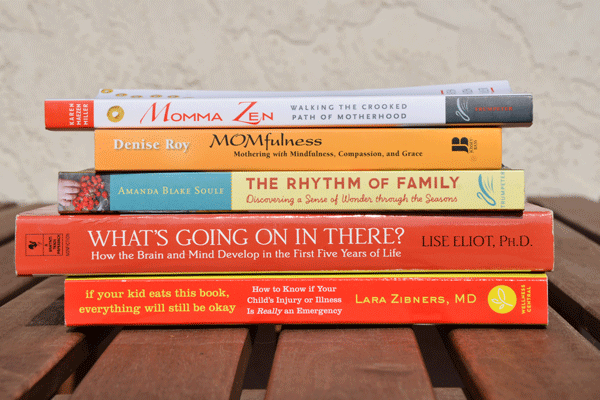
Parenting Books That Aren't, But I Love Them Anyway. Pt 1

So I know that I have a book review blog, and some of these may be (are probably) reviewed over there, but I thought since I write about mommying over here, I would compile a list for easy reviewing. This is Part one because there are a few I haven't read, a few I'm sure I'm forgetting, and a few I remember but don't own. Part one is the ones I own.


Momma Zen by Karen Maezen Miller
(If you click on that link, it reviews both of Karen Maezen Miller's books, as well as She Looks Just Like You by Amie Klempnauer Miller. The latter is a memoir of motherhood by a (nonbiological) lesbian mother. It is well worth the read as well.)

Momma Zen is full of essays and meditations I pick up and peruse over and over again. The subtitle is "Walking the Crooked Path of Motherhood" and that is exactly what all mother's need to be reminded of: it's a crooked path. Miller is a Zen Buddhist Priest who recognizes that we are all so many things and that what the cure is for those things that ail us is to accept them and give them time and space to resolve. This book is full of little meditations, with a handy index in the back to direct you to the one you want for your particular hard moment. Entitled: "For the Hard Days" (because no one needs help during the happy times) it has meditations for everything from Balance to Trust. There's even a little "How to Meditate" primer thrown in for good measure.

What makes this book special is that she's not saying "this is how you do it," she saying "this is how I do it, and it helps me, so it might help you." And then leaving you to make your own decisions and form your own opinions.

(I read her blog and follow her on facebook. You can, too.)


Momfulness by Denise Roy

Roy has a Masters in Divinity and is a licensed marriage and family therapist. Her first book, My Monastery is a Minivan was exactly what I needed when I found it. (Click on the link above to find my reaction to it.) While that book was a memoir, this is a handbook. It is full of little rituals to helps you mother (although it would work for fathers, too) with mindfulness, compassion, and grace. It's one I give frequently as a baby shower gift.


The Rhythm of the Family: Discovering a Sense of Wonder Through the Seasons.
by Amanda Blake Soule with Stephen Soule

Soule's other two books, The Creative Family and The Handmade Home both have a spot on my bookshelves. Those are craft-based books, though, so I didn't review them (maybe that could be my next big book list...) and somehow, even though I read this one in October, I neglected to review it. Which is a shame, because it is amazing.  It is broken down by month, with an essay by Mama and an essay by Papa on each's reflections of that time of year. Following that are a handful of projects for each month/season that are easy for the whole family to participate in. As a mother of 5, she's well practiced in encouraging the young ones to get involved - her confidence inspires me to let go a little and let my own son try his hand at the things he shows interest in.
The have a blog, full of photos and adventures of their life on their farm in Maine - it's just enough outside of my realm of experience (SNOW! For months!) that if I have never felt anything but inspired. Find her here, and on twitter here.

What's Going on in There? How the Brain and Mind Develop in the First Five Years of Life by Lise Eliot, Ph.D.

This is not a book for the casual reader. But it is chock-full of information on your baby's brain. If you follow the link above there's a decent review. I honestly have only picked this up since reading so that I could double check a few of her milestone charts, but I feel like I retained enough that it's helping my parenting. If you're a science nerd with nothing to read: you won't go wrong here.

If Your Kid Eats The Book, Everything Will Still Be Okey: How to Know if Your Child's Injury or Illness is Really and Emergency by Lara Zibner, MD.

This is another baby-shower gift, and here's why: she deals with the stuff that freaks a parent out in the middle of the night: swallowed coins, bumped heads, cuts, scrapes, fevers, poisoning, bites, rashes, the "plumbing"...she doesn't give two shakes if you've vaccinated or not, or if your doctor is homeopathic or conventional. She focuses on the injury and whether or not it needs to be seen by a trained professional. I've consulted it a LOT in the past two years, and I'm certain I will continue to as the years progress.

The best nugget of wisdom so far? (ok, there are two)

1) The 3/3 rule for head bumps: under 3 months of age, or if they fall over 3 feet onto their head, it's time to consult a doctor. (She lists other symptoms to look out for, but that the basic rule of thumb.)

2) Vomit always looks more voluminous than it is and the only color you should worry about is christmas-tree green or if it's pure blood.

If you're a parent or a care-giver, there's no reason not to have this on your shelf.


So that's a good start. Part two will publish after I've read Mayim Bialik's new book.


Related Posts with Thumbnails